
Ruth Ige
The Evocation of Worlds

Time and location
23 AUG – 15 NOV 2026
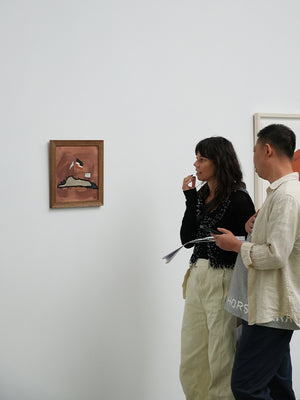
Winner of the 2025 Rydal Art Prize, Ruth Ige presents a new body of work that extends her ongoing exploration of identity, belonging, and representations of Blackness. Through richly layered paintings, Ige creates cumulative worlds where history, poetry, mythology, speculative fiction, ancestral practices, and future imaginings converge. Her practice unfolds at the threshold between lived experience and mythology, where everyday life and the otherworldly are not separate realities but overlapping ways of understanding existence. Ige weaves cultural references into a mythology of her own, allowing inherited knowledge and contemporary imagination to coexist without collapsing into one another.
Across these works, Blackness is understood not as a singular experience but as a multiplicity of histories, memories, and possibilities that resist fixed definitions. Figures emerge between abstraction and figuration, concealment and revelation, inhabiting spaces where past, present, and future coexist. Mystery is central to this practice: The artist is not interested in presenting easy legibility or fixed narratives, instead, she allows space for uncertainty and ambiguity. Her work attends to what can no longer be fully known, and to the absences left by colonial disruption – where what has been disrupted can often only be sensed through traces, memories, and felt connections. Rather than withholding meaning, mystery becomes a form of protection and empowerment, allowing her subjects to remain powerful without being made entirely available to the viewer.
The Evocation of Worlds marks a deepening of this enquiry through the artist’s understanding of painting itself. Drawing on her Yoruba heritage through her father and Igbo heritage through her mother, Ige approaches painting not simply as a means of representation but as a practice of evocation. Across many Nigerian traditions, artistic and spiritual practices have long existed in close relation, with painting, carving, weaving, beadwork, and metalwork participating in acts of ancestral veneration and spiritual invocation. Inspired by these histories – without seeking to replicate their sacred forms – Ige considers painting as a medium capable of evoking ancestral memory, protection, healing, language, liberation, and imagined futures. Many of her paintings hold a space of beckoning and invocation, where what is remembered, desired, or not yet realised begins to gather form, inviting viewers to enter its realm, to imagine possibilities that exceed inherited systems of knowing.
This understanding resonates throughout the exhibition’s material language. Alongside acrylic paint, Ige incorporates West African indigo and Nigerian earth clays, camwood (osùn) powder, leaves and other organic materials whose meanings shift between the everyday and the sacred. These materials, used not only in food but also in healing, adornment, ceremony, and spiritual practice, carry cultural, as well as ecological and ancestral histories that exceed their physical form. With the recurring use of shea butter in the paintings, a material used across many African countries for self-care and bodily wellbeing, Ige expands “healing” into a broader practice of remembrance, connection, and renewal. Within the paintings, these materials become pigment, archive and offering simultaneously: honouring Black life while preserving, activating, and renewing forms of knowledge and connection that have travelled and survived across generations and throughout the African diaspora.
Running throughout the exhibition is a commitment to world-building through imagination. For Ige, imagination is not an escape from reality but a necessary condition for liberation. When systems shaped by colonial histories fail to make space for certain lives and ways of knowing, new possibilities must first be imagined before they can be realised. Her paintings offer spaces of rest, protection, and reconnection with self, ancestry, and community, while holding together beauty and grief, intimacy and power, the familiar and the fantastical.
The exhibition takes its title from a poem written by the artist:
Painting
An evocation
The evocation of the unknown
The evocation of healing
The evocation of power
The evocation of worlds
These lines offer a key to the exhibition as a whole: The works gathered here are acts of remembrance and imagination, both archive and offering, carrying histories while calling new futures into being. They evoke liberation, healing, protection, and belonging, affirming painting as a space where possible futures can be imagined before they are lived.
Curated by Anja Lückenkemper
Ruth Ige is the recipient of the 2025 The Rydal Art Prize. The Rydal Prize is one of Aotearoa’s biggest art prizes with a biennial award of $25,000.
The exhibition is generously supported by the Seeds Trust.
Image Credits | Ruth Ige, You deserve every good thing 2026,


Ways to engage

Ruth Ige Informal Encounter
You are warmly invited to join us for a morning of art with the Ruth Ige.
Learn More
Help keep Te Uru humming
Te Uru plays a leading role in sharing contemporary art with diverse audiences. your support enables us to continue this important work by making our exhibitions and programmes accessible to everyone. By donating to Te Uru, you are contributing essential funds to the development of art in Aotearoa, and the communities it nourishes.