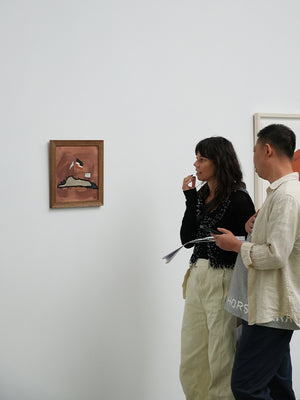

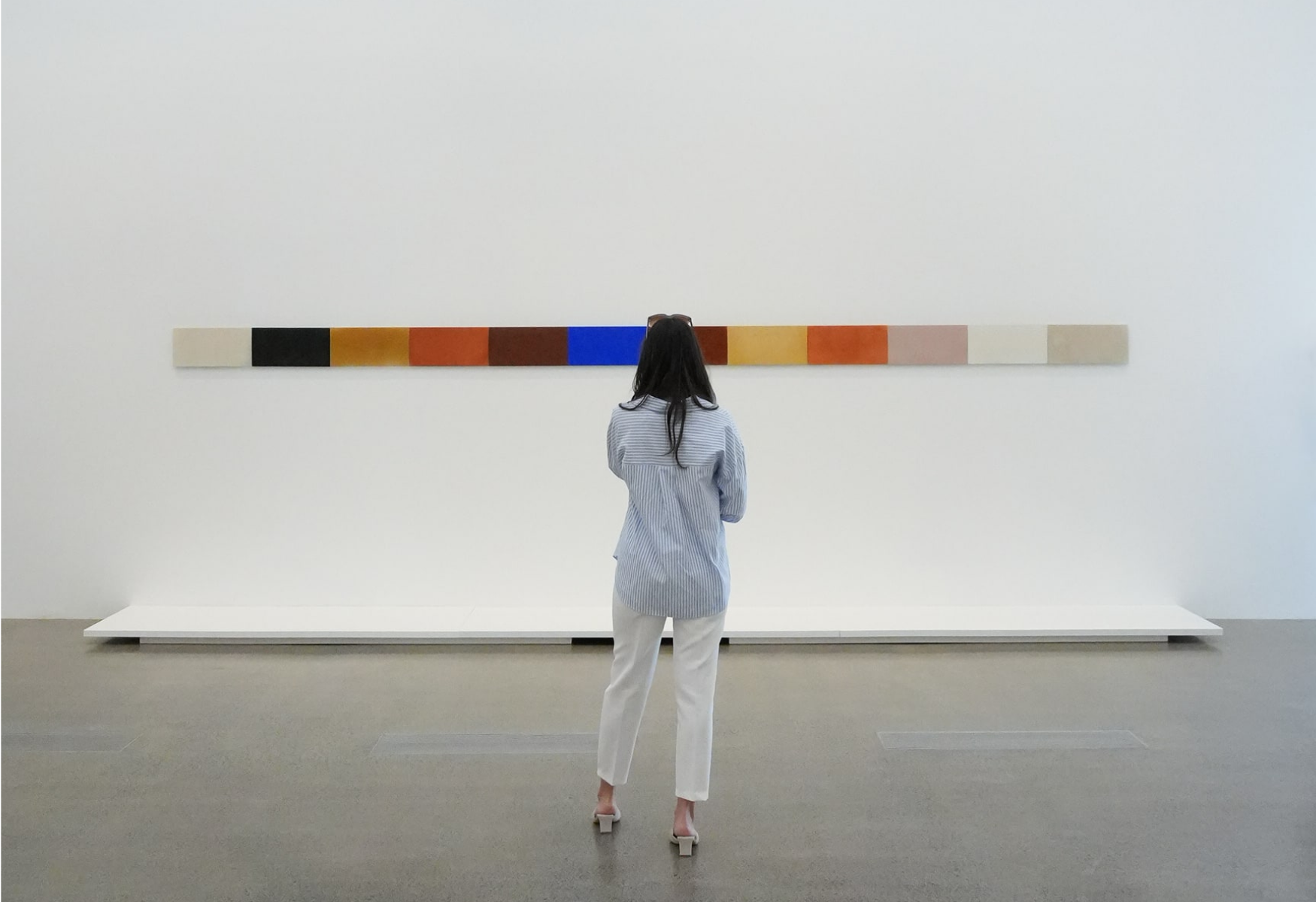
Sione Faletau, Kauri Hawkins, Raymond Sagapolutele
Herehere

Time and location
16 MAY – 26 JUL 2026
Herehere
(verb) to tie up, bind, shackle, restrain.
(noun) a captive, a prisoner, the accused.
Tāmaki Makaurau is often described as a meeting place — Tāmaki of a hundred lovers — a site of convergence and desire. It is also highly contested land, a site of seizure, and of control. The city’s history is not only one of movement and exchange, but one of stolen land and enforced belonging. The cords that bind Tāmaki Makaurau together have also been used to dispossess or shackle the people here.
Colonial occupation in the 1840s violently disrupted existing Māori systems of authority, land tenure, and kinship. Through land confiscation, legislation, and the steady erosion of tino rangatiratanga, mana whenua were displaced from ancestral lands and waterways, which were reshaped to serve a settler city. Urbanisation in the mid-twentieth century (framed as opportunity) was a strategy of forced assimilation, drawing Māori into industrial labour while severing intergenerational relationships to whenua. The promise of participation in modern city life came with conditions: to adapt, to relocate, to conform.
Pacific immigration in the 1960s and 70s was similarly structured by labour demand and state control. Due to labour shortages, Pacific peoples were enticed to uproot their families and move to Tāmaki Makaurau to fill industrial roles. Then later targeted and blamed when the economy faltered. The Dawn Raids of the 1970s exposed how quickly “welcome” could turn to criminalisation — homes entered before sunrise, brown bodies rendered suspect and policed. Here, binding took on its most literal sense: detention, accusation, deportation. The state decided who could be here, at what time, and on what terms
The kupu herehere offers a framework for reading these histories. To bind can be to shackle, to confine, to render captive. It can also be to connect, to hold fast in care and reciprocity. In Tāmaki Makaurau, identity is shaped within the tension — between; collective strength and imposed constraint, and between chosen affiliation and enforced marginality.
The artists gathered in this exhibition confront these bindings directly.
Raymond Sagapolutele’s (b. 1971, Fatuvalu and Saluafata, Samoa) Diasporanaut works position the Pacific body as navigator and cosmic traveller — exploring the liminal space between homeland and diaspora. Neither fixed nor contained by colonial borders, the figure moves through speculative, relational space, reasserting agency in a place far from home. The diasporic subject becomes self-determining, charting routes beyond the nation-state.
Kauri Hawkins (b. 1995, Ngai Tāmanuhiri, Rongowhakaata, Ngāti Porou, Ngāti Pahauwera, Rarotonga) engages the material and symbolic residues of occupation and assimilation, examining how land, architecture, and institutional systems continue to structure Māori experience. His practice exposes the infrastructures — legal, spatial, economic — that naturalise displacement, asking how inherited constraints might be dismantled or re-bound on different terms.
Sione Faletau (b.1991, Taunga, Vava’u, and Lakepa, Tongatapu) works with projected kupesi (patterns) generated from sound waves, translating voice and vibration into shifting fields of light. His works render language and genealogy visible as rhythm and frequency, asserting presence through resonance rather than figuration. When cast onto surfaces, these luminous waveforms reclaim space in a city where Pacific bodies have been policed and marginalised. Faletau’s projections insist on visibility grounded in cultural transmission — Tongan identity as dynamic, enduring, and irreducible to imposed narratives.
Together, these practices demonstrate that Tāmaki Makaurau is not a neutral ground of encounter. It is a city built through layered acts of binding — some forged in solidarity, others imposed through force. To be here is to inherit these entanglements. Herehere asks: who has the power to bind, and who is bound? What knots must be loosened? What new ties might be formed in solidarity and reciprocity? In a city continually being remade, the act of binding must be reclaimed not as restraint, but as collective strength and self-determination.
Curated by Hōhua Thompson


Help keep Te Uru humming
Te Uru plays a leading role in sharing contemporary art with diverse audiences. your support enables us to continue this important work by making our exhibitions and programmes accessible to everyone. By donating to Te Uru, you are contributing essential funds to the development of art in Aotearoa, and the communities it nourishes.